

by: Belva Almarhea Shafa
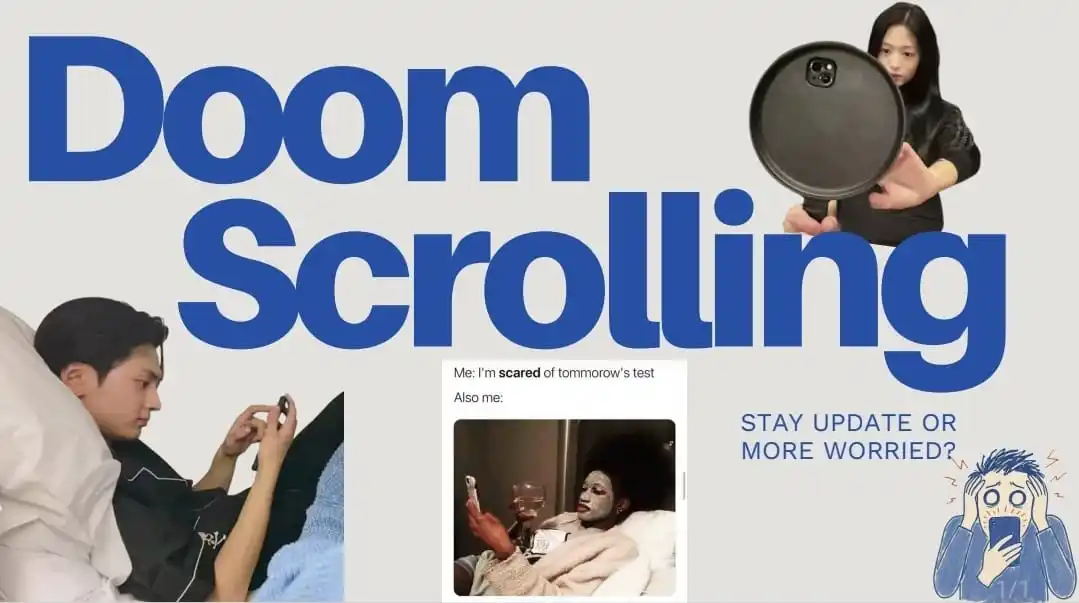
You open your phone just to check what’s happening today. Maybe there’s a new update, a story everyone is talking about, or something you feel like you should know. One video turns into another, one headline leads to another, and suddenly, you’ve spent the last 20 minutes scrolling through stories about disasters, conflicts, diseases, crime, and everything else happening in the world. You put your phone down, but instead of feeling more updated, you somehow feel more worried than before. So, why do we keep scrolling when all we wanted was to stay updated?
Scrolling has become a normal part of how we consume information. We scroll while waiting for class to start, during a study break, or simply when we have nothing else to do. But doomscrolling is a little different. It refers to the habit of continuously consuming negative or distressing content, often for longer than we originally intended.

Doomscrolling does not necessarily belong to one particular generation. In fact, research has increasingly examined its relationship with mental well-being. A 2026 systematic review and meta-analysis by Li and Yin, which examined 44 studies, found that doomscrolling was associated with anxiety, depression, psychological distress, and lower psychological well-being. However, the researchers also noted that the available evidence cannot establish that doomscrolling directly causes these problems.
About this situation, not everything mean that someone enjoys bad news or wants to feel anxious. Sometimes, it starts with something as simple as wanting to know what’s going on. But attention is only part of the story. What happens after we see that first piece of information? We might click on another post to understand what happened, search for an explanation, check for updates, or look for reassurance. What started as a quick attempt to stay updated can slowly become a search for more and more information. And when we are not sure whether we have found enough answers, it can become even harder to stop.
One possible explanation is our discomfort with uncertainty. In psychology, this is often described as “intolerance of uncertainty”. The tendency to find uncertain situations difficult to deal with and to want clearer answers. When something worrying happens, searching for information can feel like a way to regain a sense of control. We check the latest updates, look for explanations, and try to figure out what might happen next.
The problem is that online information rarely gives us a definite ending. One answer can lead to another question. A news update may make us wonder whether the situation will get worse, whether it could affect us, or what other people are saying about it. So we keep searching, hoping that the next post will finally give us the certainty we are looking for.
A 2025 study by Türk-Kurtça and Kocatürk offers some insight into this pattern. Studying 443 participants, the researchers found that intolerance of uncertainty was positively associated with doomscrolling. Their findings also suggested that intolerance of uncertainty and psychological resilience helped explain the relationship between trait anxiety and doomscrolling.
In other words, for some people, scrolling may not simply be about wanting more content. It can also be part of an attempt to deal with not knowing what will happen next. The more uncertain a situation feels, the more tempting it may be to keep searching for information that might finally make things feel clearer.


But there is a catch. The internet can give us an enormous amount of information without ever giving us a definite answer. A new update can change the story, a different source can offer a different perspective, and one answer can create three more questions. At some point, staying informed can start to feel less like gaining control and more like trying to catch up with an endless stream of information.
This may be one reason why doomscrolling is associated with poorer psychological well-being. It is not necessarily the information itself that is the problem. Sometimes, it is the feeling that we still need to keep looking.
That feeling matters because doomscrolling has been linked to several aspects of mental well-being. Li and Yin’s 2026 systematic review and meta-analysis found associations between doomscrolling and anxiety, depression, psychological distress, and lower psychological well-being across 44 studies. A 2026 scoping review by Sharpe and colleagues similarly found that many existing studies reported relationships between doomscrolling and anxiety, stress, depression, and reduced resilience.
Still, these findings need some context. Many of the studies included in existing reviews are cross-sectional, meaning they look at people’s experiences at a particular point in time. They can show that doomscrolling and poorer mental well-being are related, but they cannot tell us for certain which one came first. It is possible that frequent doomscrolling contributes to feeling worse, but it is also possible that people who are already feeling distressed are more likely to scroll for information. Both patterns may even occur at the same time.
So the issue may not be as simple as “doomscrolling is bad for you”. What matters is the pattern behind the scrolling. Checking a few updates because you want to understand what is happening is different from repeatedly searching for information even when you already feel overwhelmed.
Being informed can be useful. But there is a point where another update does not make us more prepared. It will simply give us something else to worry about.
So, what can we actually do about it? The answer does not have to be deleting every social media app or avoiding the news altogether. Staying informed is still important. The goal is to notice when scrolling is helping us understand something and when it is simply keeping us stuck in the search for more information.
One simple place to start is by asking yourself why you opened your phone in the first place. Are you looking for a specific update, or are you scrolling without really knowing what you are looking for? If you came for one piece of information, getting the answer and stepping away may be enough. It can also help to take breaks from constant updates, especially when you notice that more scrolling is making you feel more overwhelmed rather than more informed.
The world will keep producing headlines long after we put our phones down. There will always be another story to read, another update to check, and another question waiting for an answer. We cannot know everything, and we were never meant to.
Sometimes, staying informed means knowing when to stop looking. Because the goal was never to know everything. You came to stay updated, but give yourself permission to stop. Your attention does not have to belong to everything happening in the world.
References
Li, Q., & Yin, X. (2026). Doomscrolling, mental health, and psychological well-being in adolescents and adults: A systematic review and meta-analysis. Frontiers in Psychology, 17, 1893800. https://doi.org/10.3389/fpsyg.2026.1893800
Mayo Clinic Press. (2024, April 18). Doomscrolling: Stop the scroll, protect your mental health. Mayo Clinic.
Shabahang, R., Hwang, H., Thomas, E. F., Aruguete, M. S., McCutcheon, L. E., Orosz, G., Hossein Khanzadeh, A. A., Mokhtari Chirani, B., & Zsila, Á. (2024). Doomscrolling evokes existential anxiety and fosters pessimism about human nature? Evidence from Iran and the United States. Computers in Human Behavior Reports, 15, 100438. https://doi.org/10.1016/j.chbr.2024.100438
Sharpe, A. T., Tyndall, I., Poulus, D. R., Obine, E. A., & Sharpe, B. T. (2026). The influence of doomscrolling on mental health: A scoping review. Mental Health and Digital Technologies, 3(3), 290–342. https://doi.org/10.1108/MHDT-10-2025-0068
Smith, S. (2025, November 3). Inside the psychology of doomscrolling: Why it happens and how to stop. Middle Georgia State University.
Türk-Kurtça, T., & Kocatürk, M. (2025). Beyond the scroll: Exploring how intolerance of uncertainty and psychological resilience explain the association between trait anxiety and doomscrolling. Personality and Individual Differences, 233, 112919. https://doi.org/10.1016/j.paid.2024.112919
WGLT. (2025, August 14). How doomscrolling looks across different generations—and how to manage it. WGLT.