

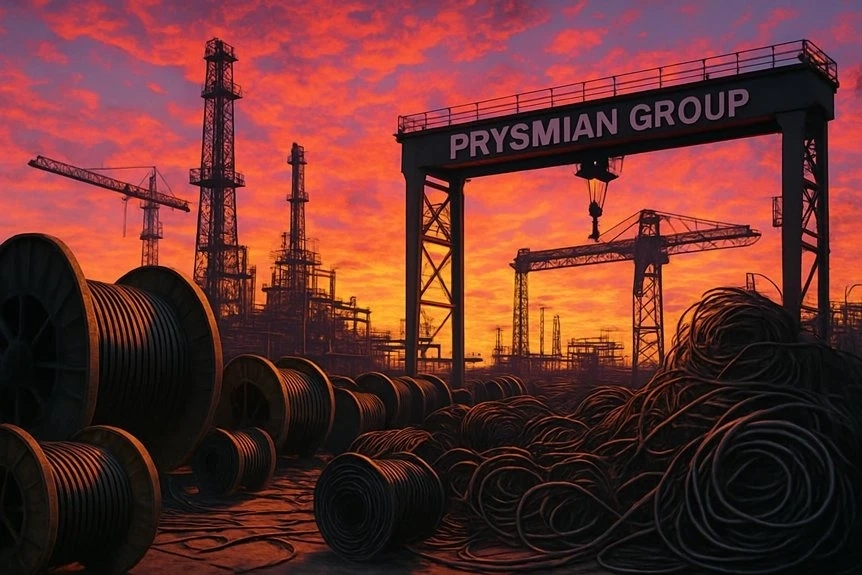
Prysmian Group occupies a distinctive position in global infrastructure. The Italian-headquartered manufacturer produces cables and systems that underpin energy transmission and digital communications worldwide. Its operations span continents, its contracts involve governments and utilities, and its engineering capabilities extend from subsea interconnectors to fiber optic networks. Understanding precisely how Prysmian operates and why major infrastructure stakeholders consistently choose it will require a closer examination of what the company actually builds and deploys.
What Does Prysmian Group Actually Make?
Prysmian Group engineers and manufactures a broad portfolio of cables and systems designed to transmit energy and data across demanding environments. Its diverse product portfolio spans high-voltage underground and submarine power cables, medium- and low-voltage distribution cables, optical fiber cables, and specialty cables for industrial, automotive, and telecommunications applications. The company serves utilities, energy operators, telecommunications providers, and infrastructure developers globally.
Vertically integrated operations allow Prysmian to control production from raw material processing through finished cable systems, ensuring quality consistency and supply chain reliability. Key product segments include the Energy segment, covering power transmission and distribution solutions, and the Telecom segment, addressing high-speed data transmission needs.


This structural breadth positions Prysmian as an extensive solutions provider rather than a narrowly focused component supplier.
Where Prysmian Group Operates and How Far Its Reach Extends
The scale of operations required to support such a diverse product portfolio demands a manufacturing and commercial footprint of considerable geographic scope. Prysmian Group maintains a global manufacturing presence spanning over 50 countries, with more than 100 production facilities distributed across Europe, North America, South America, Asia-Pacific, and Africa.
This international footprint positions the company within proximity of key demand centers, reducing logistical complexity while enabling localized compliance with regional technical standards. Approximately 30,000 employees operate across this network, supporting both manufacturing output and commercial distribution channels.

The company’s headquarters remain in Milan, Italy, though operational authority is distributed across regional divisions. Such geographic breadth allows Prysmian to simultaneously address infrastructure requirements in mature markets while pursuing expansion opportunities in developing economies where electrification demand continues accelerating.
The Energy Grids, Subsea Links, and Fiber Networks Prysmian Supplies
Much of the infrastructure underpinning modern economies depends on cable systems that Prysmian Group supplies across three distinct but interconnected segments: high-voltage energy transmission networks, subsea interconnection links, and fiber optic telecommunications infrastructure.
Its high voltage transmission cable solutions serve national grid operators requiring reliable bulk power transfer across extended distances, including HVDC corridors linking renewable generation sites to load centers.


Subsea cable installation techniques employed by Prysmian enable deployment across challenging seabed environments, connecting offshore wind farms, cross-border energy interconnectors, and island grids to continental networks.
Simultaneously, its fiber optic division supplies structured cabling and backbone infrastructure supporting broadband expansion and data center connectivity.
These three segments collectively position Prysmian as a systemic supplier to both energy shift projects and digital infrastructure programs worldwide.
How Prysmian Group Is Driving the Global Energy Transition
Decarbonization imperatives across global energy markets have elevated the strategic relevance of high-capacity cable infrastructure, positioning Prysmian Group at the operational center of efforts to restructure power generation and distribution networks.
The company’s product portfolio directly enables renewable energy infrastructure deployment, supplying high-voltage cables for offshore wind installations, solar interconnections, and hydroelectric transmission corridors. Grid modernization initiatives increasingly depend on Prysmian’s underground and submarine cable systems to replace aging overhead transmission lines with higher-capacity, lower-loss alternatives.
Its HVDC technology facilitates long-distance power transmission essential for integrating geographically dispersed renewable generation into unified grid architectures. Through sustained investment in manufacturing capacity and engineering capability, Prysmian has established itself as a technically indispensable supplier within the structural shift away from fossil fuel-dependent energy systems.
Why Utilities and Governments Trust Prysmian Over Other Cable Makers
Sustained institutional confidence in Prysmian Group among utility operators and government procurement bodies derives from a convergence of technical qualification standards, demonstrated project execution capability, and long-term supply reliability that few competitors can match at equivalent scale.
Prysmian’s reliable track record across high-voltage direct current interconnectors, submarine grid infrastructure, and urban distribution networks has established measurable performance benchmarks that procurement evaluators consistently reference. Its vertically integrated manufacturing structure mitigates supply chain exposure, reducing delivery risk on mission-critical contracts.
Additionally, Prysmian deploys innovative solutions across cable system engineering, including advanced thermal monitoring, dynamic rating technologies, and customized installation methodologies tailored to complex grid environments. Regulatory compliance across multiple international certification frameworks further reinforces institutional confidence, positioning Prysmian as a preferred strategic partner rather than a transactional supplier within global energy infrastructure procurement.